.png?width=666&height=414&name=Child%20Care%20Aware%20Logo%20(1).png "Child Care Aware of Missouri Logo")
Five Signs Child Care May Be Affecting Your Workforce
.png)
Child care challenges do not always look like child care challenges at work. They may show up as scheduling difficulties, attendance issues, unfilled shifts, or missed opportunities for advancement.
For employers, the key is knowing when to look beyond the surface. At Child Care Aware® of Missouri, we see how access to child care can affect both working families and the businesses that depend on them.
Here are five signs worth watching and what you can do with that information.
1. The Same Shifts Are Difficult to Fill
Early mornings, evenings, weekends, rotating schedules, and last-minute changes can be difficult to match with available child care.
Look deeper: Are certain shifts consistently harder to staff? Are people willing to work more hours, but only at certain times?
Try this: Ask whether schedule predictability or caregiving responsibilities affect availability. What appears to be a staffing shortage may sometimes be a mismatch between work schedules and available child care.
2. Attendance Challenges Follow a Pattern
Do not look only at the number of absences. Look at when they happen. Late arrivals, early departures, school breaks, or recurring problems during certain shifts may reveal a pattern.
Try this: Review attendance by shift, time of day, and season. Greater schedule predictability, advance notice of overtime, or access to child care resources may help address the underlying issue.
3. People Want More Hours but Are Not Taking Them
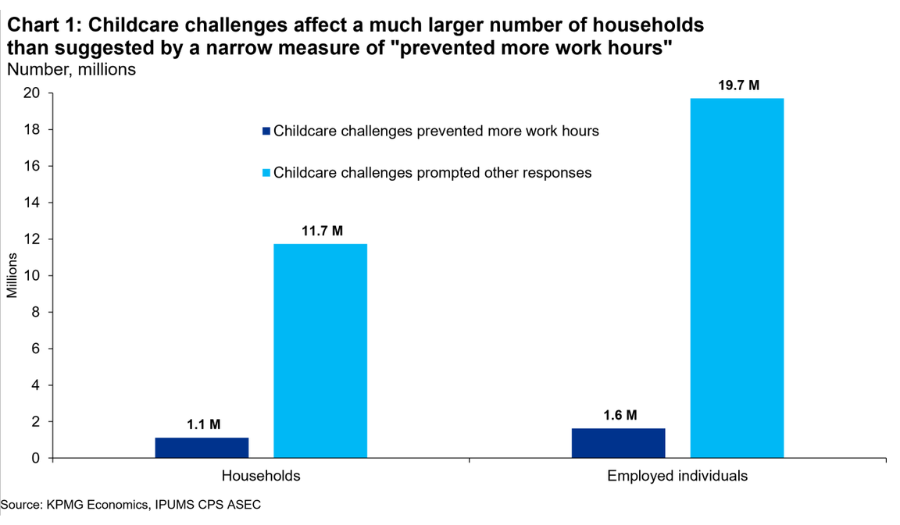
Declining overtime or additional shifts can easily be interpreted as a lack of interest. In some cases, a worker may want the additional income but cannot secure child care that matches the hours being offered.
This is particularly worth examining when a business experiences unfilled shifts while members of the workforce indicate they want additional hours.
Try this: Use a short pulse survey asking what prevents staff from accepting additional hours. Include options such as caregiving, transportation, schedule notice, another job, or personal preference.
This gives business leaders useful information instead of requiring them to guess why additional hours are being declined.
4. Advancement Opportunities Are Not Reaching Everyone
Training, travel, shift changes, and after-hours events can create barriers for working parents, even when they are ready to advance.
Look deeper: Who participates in development opportunities, and who does not? Before assuming a lack of interest, consider whether the timing or structure of opportunities may be limiting participation.
Advance notice, alternative training times, virtual options, or more predictable scheduling may make a difference.
5. You Have Never Asked
If your business has never asked about caregiving barriers, you may not know how much child care affects your workforce.
Try this: Consider a brief, anonymous survey asking whether caregiving responsibilities have affected scheduled hours, additional shifts, training, or advancement, and whether access to child care information would be helpful.
Compare the responses with attendance, scheduling, vacancy, and turnover trends. You may discover that a workforce challenge you have been addressing under one name has a different underlying cause.
Start With Information, Not a New Benefit
Recognizing that child care may be affecting your workforce does not mean your business must immediately create a new or expensive employee benefit.
Start with information. Review workforce patterns. Ask questions. Listen to what staff members are experiencing. Then make sure HR leaders and managers know what resources are already available.
Child Care Aware® of Missouri operates Missouri Childhood Resource & Referral (MCRR), a no-cost statewide resource for Missouri families. Through MCRR, families can receive help finding child care, navigating child care subsidies, accessing community resources, and receiving more personalized Child Care Concierge assistance when additional help with a child care search is needed.
For employers, this means there is already a resource available that can be shared with the workforce without having to create a new child care program.
Action: Share this article with managers and HR leaders, then choose one place to begin: review your workforce data, survey staff about caregiving barriers, or make MCRR and other available child care resources easier for your workforce to find.
Email ccw@mochildcareaware.org to learn about the MCRR service.
Explore our other Child Care Aware® of Missouri resources:
Clock Hour Training
Scholarships for Educators
Child Care Health and Wellness
Family Child Care Network
Leadership Development Opportunities
Missouri Office of Childhood Updates
Show Me Child Care Resources
Support Child Care Aware® of Missouri
Community Data
Join Our Team
Resources to Build Your Business